0006-Assurance System for DroneUp Services

| Status | Approved |
| Owner | Mesgana Asmelash |
| Contributors | Jake Goldsberry, Alexander Fomenko, Colin Blues, Irina Prozhoha |
Decision Log
Decision: Accepted, contingent on drafting a preliminary set of product requirements and seeing if ResilienX would be a good partner-fit. Outline the resources and timeline required for the planning phase. Distinguish the definitions for observability, monitoring and assurance (i.e. where would HoneyComb, Grafana fit into this assurance system concept?). Take inspiration from Argus Tiger Team’s work. Define the scope for applicability (e.g. ATOM etc.).
Problem Statement
As a service provider supporting current Part 107 and Part 135 operations and preparing for the Part 108 Automated Data Service Provider (ADSP) role, we lack a centralized real-time assurance system to continuously confirm that our services are functioning as expected, detect when they are not and trigger timely mitigation plans. This gap creates unacceptable risks for safety-critical operations that depend on our services for regulatory compliance, mission continuity and airspace access. Without a robust, proactive assurance capability, we risk undetected service degradation, loss of operator trust and heightened regulatory exposure under the forthcoming FAA Part 146 framework.
Importance of Solving the Problem Now
FAA’s proposed Part 146 rule will require Part 108 operators to use certified ADSPs and certification depends on proving that services consistently meet safety, performance and reliability expectations. These expectations include service integrity, availability, timely fault detection and the ability to mitigate issues before they affect flight safety. These capabilities cannot be retrofitted overnight. Building a robust assurance system takes time. Observability must be designed into the system, performance thresholds must be defined and incident responses tested under real-world conditions.
Delaying this work risks turning a strategic investment into a rushed compliance scramble. Once certification becomes mandatory, ADSPs that haven’t already validated their assurance capabilities will face significant obstacles to market entry and operator trust. Early action not only reduces the risk of costly retrofitting, it allows us to help shape how the FAA defines compliance during this rule-making window. Operators already depend on service providers for mission-critical decisions and failure to detect and respond to degradation could lead to violations and reputational loss. The time to act is now.
Why Should the Business Pursue This?
Drone operators must prove that their missions are safe and compliant and they need infrastructure partners they can trust. By delivering a service backbone with built-in assurance, the business becomes their most dependable choice, driving adoption and long-term retention. Building this capability now signals to the FAA and industry that we prioritize reliability, giving us an early mover advantage. While assurance will soon become table stakes under Part 146, building it early transforms it into a strategic differentiator. It enables influence over regulatory interpretation, accelerates certification readiness and builds operator confidence at a time when alternatives may not yet meet that bar. Without this foundation, undetected service failures could result in mission delays, liability or regulatory penalties. A robust assurance layer not only shields the company from technical and reputational risks but also secures a leadership position in a rapidly evolving market.
How Does This Align with DroneUp’s Business Goals?
DroneUp is preparing for FAA frameworks like Part 108 and 146. Assurance directly supports compliance and smooth certification under these rules. The trustworthiness of our platforms (e.g. Uncrew & ATOM) hinges on our ability to deliver services that are consistently reliable and demonstrably safe, forming the foundation of our credibility with both operators and regulators.
Concept Overview
The proposed solution is the development of an Assurance System that continuously monitors, validates and reports on the performance and reliability of automated services that support drone operations. Functions such as airspace awareness (e.g. elevation API, ground-based surveillance sensors etc.), pathfinding and mission control become essential when operations demand higher levels of autonomy or complexity, especially beyond visual line of sight (BVLOS).
This system will serve as the foundation for building FAA trust and operator confidence by ensuring that any anomalies or service degradations are detected and resolved through predefined mitigation workflows before they impact operational safety or compliance.
In alignment with industry consensus standards, including ASTM F3442 (DAA Performance Specification), ASTM S-SDSP (Surveillance Supplementary Data Service Provider Standard) and the emerging IASMS (In-Time Aviation Safety Management System Guide), the Assurance System will follow a “best-of-breed” approach that consolidates requirements across applicable standards.
Concept Illustration
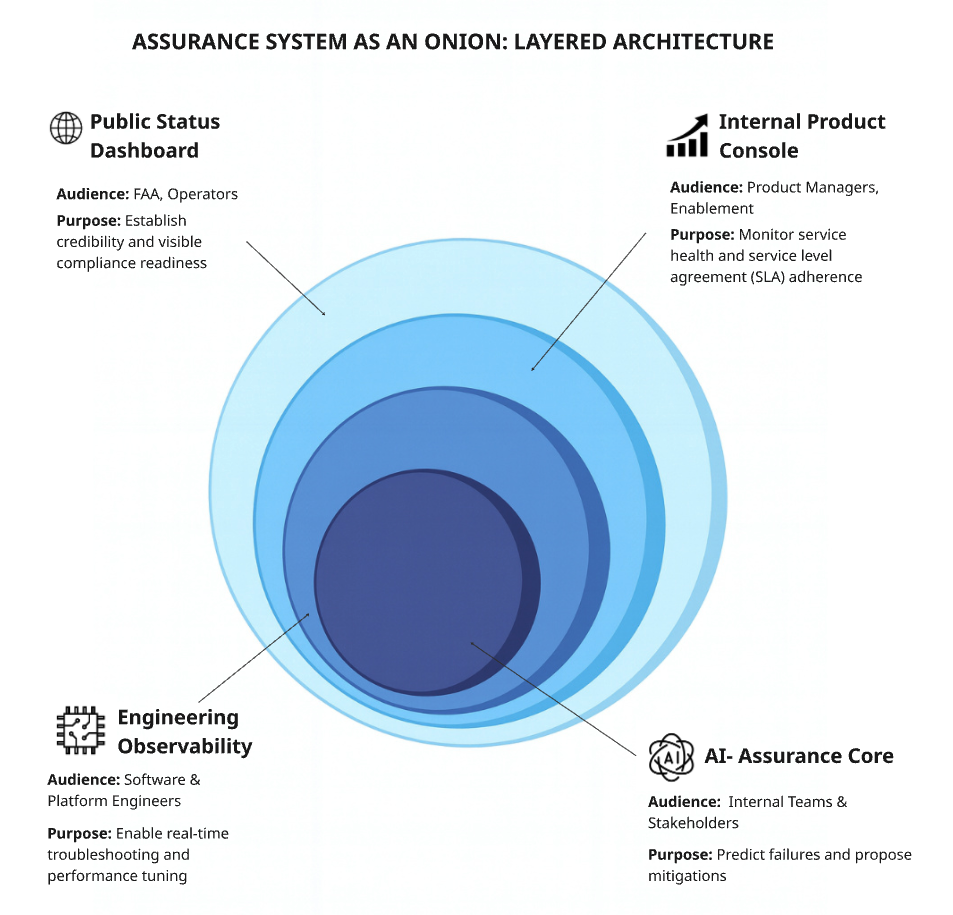
The Assurance System can be visualized as a layered onion, where each concentric ring represents a specific audience and purpose:
- AI Assurance Core (center) — a future-state capability envisioned to leverage predictive analytics for identifying potential failures and proposing mitigations. This serves as a north star guiding progressive development.
- Engineering layer — deeper system insights to proactively maintain stability and accelerate issue resolution.
- Product & Enablement layer — service-level dashboards to track health and SLA adherence.
- Public layer (outermost) — a status dashboard for FAA, operators and external stakeholders to build trust through transparency and visible compliance.
This architecture is designed to evolve over time. Early iterations will focus on centralized monitoring and real-time detection of degradations, while more advanced predictive capabilities will be layered in as feasibility improves.
Target Audience
Internal Technical Users
These users are responsible for building, scaling and maintaining DroneUp’s core services and platforms. The Assurance System provides them with:
- Real-time visibility into service health, latency and reliability across distributed systems.
- Predictive insights from the AI-assurance core to identify early degradation signals and recommend preemptive mitigations.
- Centralized logging across services to support root cause analysis, FAA reporting and event traceability.
Internal Non-Technical Users
While not directly responsible for service operation, these teams need accessible insights to deliver value, support customer onboarding and ensure compliance goals are met. The Assurance System provides them with:
- Service-level dashboards to track availability and SLA adherence across products.
- Visibility into feature performance and system stability during rollouts.
- Data to support customer onboarding and troubleshooting.
Regulatory Authorities
As FAA oversight expands under Part 146, certification of ADSPs will depend on provable reliability metrics. The Assurance System provides:
- Audit-ready evidence that services perform within defined thresholds.
- Documentation of fault detection and response protocols.
Drone Operators
While operators may not yet demand formal assurance systems, they still benefit from the outcomes:
- Greater confidence in system reliability.
- Fewer mission disruptions due to service downtime.
- Stronger positioning for their own regulatory compliance.
Other ADSPs (Integration Partners)
To deliver end-to-end situational awareness, we must interoperate with external ADSPs (e.g. TrueWeather, Involi, uAvionix). These third-party data providers benefit from:
- Integration hooks into the Assurance System for monitoring the quality of their feeds.
- Feedback loops that flag data anomalies before they affect operator trust.
- Shared assurance telemetry that strengthens their own FAA certification and adoption.
Why Wouldn’t This Succeed?
Unclear Return on Investment (ROI)
- Risk: Without immediate operator demand or regulatory enforcement, the assurance system may not drive short-term revenue, making it difficult to justify resource allocation.
- Viewpoint: It may not generate immediate revenue, but it is essential for safety, certification and credibility. Building assurance early positions us ahead of competitors once regulation or customer demand catches up.
Misalignment with Market Readiness
- Risk: If the market is not yet prioritizing certified ADSPs, early investment might outpace actual customer needs, leading to limited adoption.
- Viewpoint: Investing early enables us to influence standards, shape customer expectations and establish trust before the market matures. There is effectively a 0% chance that some form of assurance system will not be required — the only question is when and to what extent.
Regulatory Volatility
- Risk: FAA expectations under Part 146 may shift, forcing rework or additional investment to align with final rules.
- Viewpoint: Designing a modular, standards-aligned assurance system mitigates volatility. Even if rules shift, having a baseline system demonstrates proactive compliance and reduces the overall cost of late reactive changes.
Alternatives Considered
- Manual Monitoring Only: Relies on engineers detecting issues ad hoc through logs or alerts. High risk of delayed detection and inconsistent coverage.
- Service-Specific Dashboard: Internal teams could maintain isolated dashboards, but this would lack centralized visibility or cross-service correlation.
- Build vs. Buy: We have not ruled out procuring a third-party assurance platform. However, before engaging potential partners, we need to define requirements to ensure alignment with internal needs.
Appendix A: Key Terms
Automated Data Service Provider (ADSP)
Assurance
The structured process of monitoring, validating and responding to the performance and reliability of services in order to maintain compliance with regulatory standards and operational safety expectations. Specifically:
- Monitoring system health, performance metrics and service availability in real-time.
- Validating that performance remains within thresholds defined by industry standards (ASTM, FAA advisory circulars, etc.).
- Responding through corrective or mitigative actions when faults occur.
- Recording events to enable investigation, reporting and continuous improvement.
The term ‘assurance’ is used variably across aviation standards (e.g., SORA robustness levels, ASTM performance specifications). For this concept, it is scoped to mean the operational monitoring, validation and response framework described above.
ASTM F3442 – Detect and Avoid (DAA) Performance Specification
ASTM S-SDSP – Surveillance Supplementary Data Service Provider Standard
Beyond Visual Line of Sight (BVLOS)
FAA Part 107
FAA Part 108 (Proposed)
FAA Part 135
IASMS (In-Time Aviation Safety Management System Guide)
Appendix B: Competitive Landscape / Sources of Inspiration
Slack Status Page — The Slack Status Page provides a real-time, externally accessible snapshot of service health, uptime and incident resolution, building user trust through transparency. Our public dashboard would serve a similar function.
Google Cloud Service Health & Cloud Monitoring Dashboards — Google Cloud’s Service Health Dashboard provides real-time visibility into GCP-wide outages, while Cloud Monitoring Dashboards offer customizable, granular observability for internal teams.
FRAIHMWORK/IASMS by ResilienX — Fault Recovery and Isolation, Health Monitoring frameWORK is a platform designed for real-time operational safety and performance assurance. It continuously monitors health and performance of autonomous aviation ecosystems, assesses off-nominal conditions and supports automated mitigation workflows. A potential collaborator pending further requirements definition and evaluation of partner fit.
Argus (Tiger Team Research) — A next-generation observability platform concept explored internally, designed to provide real-time monitoring, analytics and predictive insights for UAV operations. The Argus proposal outlined a path for a proof-of-concept, offering valuable insights into what it might take to operationalize assurance within DroneUp’s ecosystem.